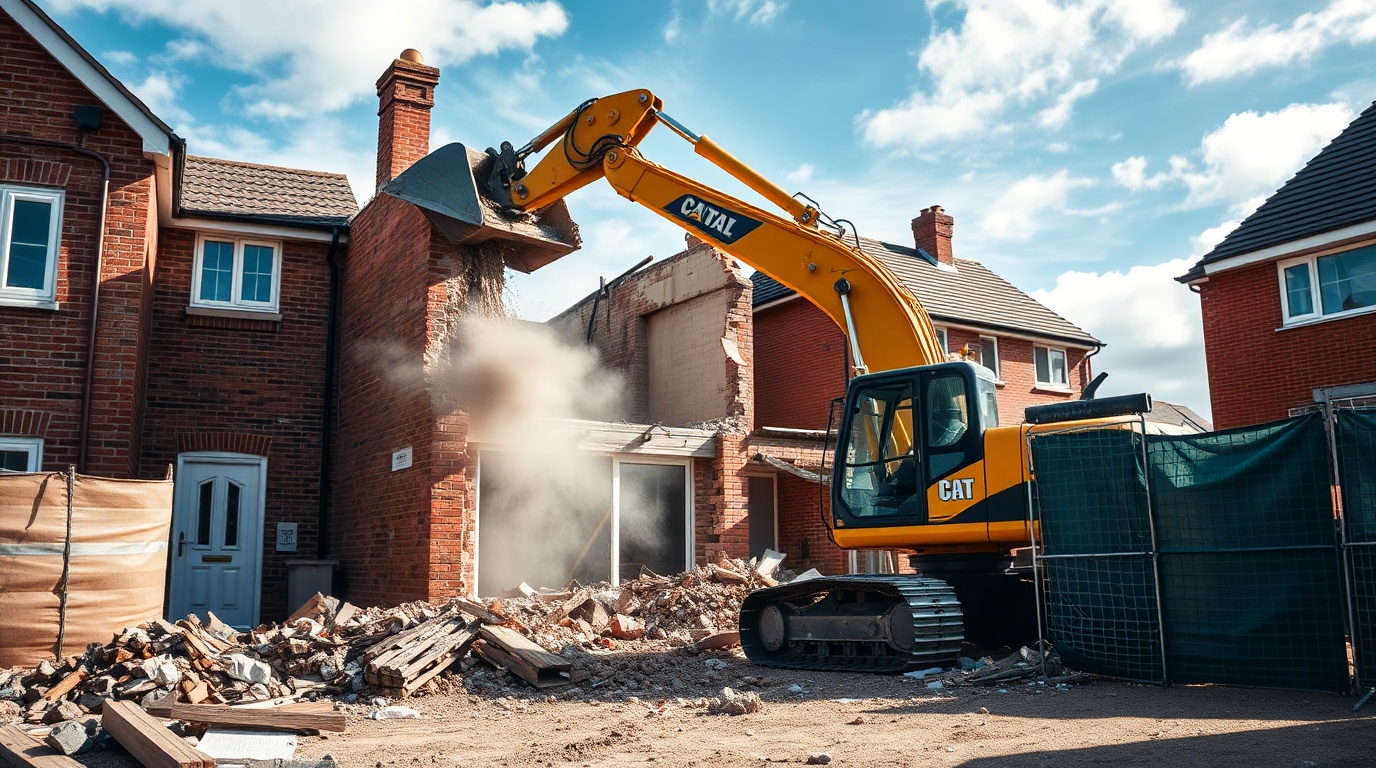
The short answer
You can own and arrange the demolition of your own house, but you cannot simply start knocking it down: house demolition is regulated work with legal duties that apply regardless of who does it. You must usually notify the local authority before demolition (and a prior approval process can apply), arrange service disconnections for gas, electricity and water through the providers, deal with asbestos through a survey and licensed removal if found, and meet health and safety requirements. For a semi or terrace, a party wall agreement protecting the neighbours is usually needed. While small, simple structures such as a shed can be a DIY job, a full house involves structural collapse risk, heavy plant, asbestos and large waste volumes, so it is almost always done by an experienced demolition contractor rather than the homeowner.
"Can I demolish my own house?" is partly a legal question and partly a practical one. The legal answer is "yes, but with strict conditions"; the practical answer is "rarely a good idea for a whole house".
DIY house demolition
- Allowed in principleYes, with conditions
- Must notifyLocal authority, usually
- AsbestosSurvey + licensed removal
- DisconnectionsThrough utility providers
- Full houseBest left to a contractor
What the law requires
Whoever carries out the work, the same legal steps apply. The table summarises the key requirements before any demolition.
| Requirement | What it means | Who handles it |
|---|---|---|
| Council notification | Tell the council before demolition | Owner / contractor |
| Prior approval | May apply to method and restoration | Local authority process |
| Service disconnections | Cap gas, electric, water | Utility providers |
| Asbestos survey | Before work; remove if found | Surveyor / licensed contractor |
| Party wall agreement | Protect neighbours (semi/terrace) | Owner + surveyor |
| Health and safety | Notifiable, with duties | Whoever does the work |
Indicative summary of UK requirements. Sources: HSE demolition guidance; GOV.UK demolition notification, 2026.
Why a full house is different from a shed
- Structural collapse risk: taking down a house safely requires understanding how it is held up and bringing it down in a controlled sequence — a serious hazard if done wrong.
- Heavy plant: a house is usually demolished with excavators and attachments, which need trained operators.
- Asbestos: houses commonly contain asbestos in roofs, flues and insulation, which is dangerous and must be handled under strict, licensed rules.
- Waste volume: a whole house produces a large mass of material to remove under waste duty-of-care rules.
What you can realistically do yourself
Small, simple, single-storey structures with no asbestos — a timber shed, a small outbuilding, a non-structural internal wall — can be a reasonable DIY task if you work safely, deal with waste properly, and check whether any permission applies. Even then, you must confirm there is no asbestos before you start, and arrange any service disconnections. For anything larger or structural, the sensible route is a demolition contractor who carries the right insurance, plant, training and waste arrangements, and who will handle the notifications, asbestos and safety duties. Some homeowners do part of the soft-strip (removing fittings and non-structural items) themselves to save cost, then hand over to a contractor for the structural demolition — but always with asbestos cleared first.
If you still want to do it yourself
For the small, non-structural jobs where DIY demolition is reasonable, a methodical approach keeps it safe and legal. The order of steps matters as much as the demolition itself.
- Confirm no asbestos first: for anything pre-2000, assume asbestos may be present and have it checked. Never disturb suspected asbestos materials yourself.
- Check whether permission applies: even a small structure can fall under planning or notification rules in some locations, so confirm with the council before starting.
- Arrange disconnections: isolate and, where relevant, have services capped before touching anything connected to gas, electricity or water.
- Plan the waste: arrange compliant disposal through a registered carrier and keep your transfer documentation, since the duty of care applies to householders too.
- Work safely and within your competence: use the right protective equipment, do not attempt structural elements you do not understand, and stop if you find anything unexpected.
For a whole house, the honest conclusion is that the combination of structural risk, heavy plant, asbestos and waste makes a contractor not just easier but materially safer and, once the liabilities are weighed, usually the more sensible choice. DIY belongs to the small, simple, asbestos-free end of the scale.
Weighing the real cost of doing it yourself
The appeal of DIY demolition is saving money, so it is worth being clear-eyed about whether it actually does. For a full house, the apparent saving on labour is often smaller than it looks once everything you would have to provide yourself is added up, and the risks attach a real cost of their own.
- Plant hire: a house is demolished with excavators and attachments. Hiring the right machine, with insurance and possibly an operator, is a significant cost in itself, and operating heavy plant safely needs training.
- Waste disposal: you would still have to arrange compliant disposal through registered carriers and pay the tipping and haulage, which is one of the largest costs whoever does the work.
- Surveys and disconnections: the asbestos survey and service disconnections are needed regardless, and you would have to arrange them.
- Time: a contractor's crew works far faster than an individual, so a DIY job ties up your time for much longer.
- Liability and insurance: if a structural element collapses unexpectedly, a neighbour's property is damaged, or asbestos is disturbed, you carry the liability. A contractor's insurance exists precisely to cover these risks.
Set against all of that, the labour you would save is often a modest fraction of the total, and you take on serious risk to capture it. This is why, for a whole house, the sensible route is almost always a competent, insured demolition contractor who already has the plant, training, waste arrangements and insurance, and who will handle the notifications, asbestos and safety duties as part of the job. Where DIY genuinely earns its place is at the small end — a shed, a small non-structural outbuilding, or a soft strip of fittings before a contractor takes over the structural work — and always with asbestos ruled out first. Knowing where that line sits is the key to deciding sensibly rather than optimistically.
Frequently asked questions
Do I need to tell the council before demolishing my own house?
Usually yes. Most house demolition must be notified to the local authority before work, and a prior approval process can apply to how the work is done and the site restored. Listed buildings and conservation areas have stricter rules. Check with your council first.
Can I remove asbestos myself during demolition?
You should not attempt to remove asbestos yourself. It must be identified by survey and, where licensed, removed by a licensed contractor under strict controls. Disturbing asbestos is a serious health and legal risk, so this is not a DIY task.
Is it cheaper to demolish my house myself?
It can look cheaper, but for a full house the savings rarely outweigh the cost of plant hire, waste disposal, surveys and the risk and liability you take on. Many people do a non-structural soft-strip themselves and leave the structural demolition to a contractor.
Sources & further reading
- HSE — demolition health and safety
- HSE — asbestos essentials
- GOV.UK — Party Wall etc. Act 1996 explanatory booklet
Figures on this page are typical UK ranges drawn from published sources and depend on your specific building. They are guidance, not a quotation.