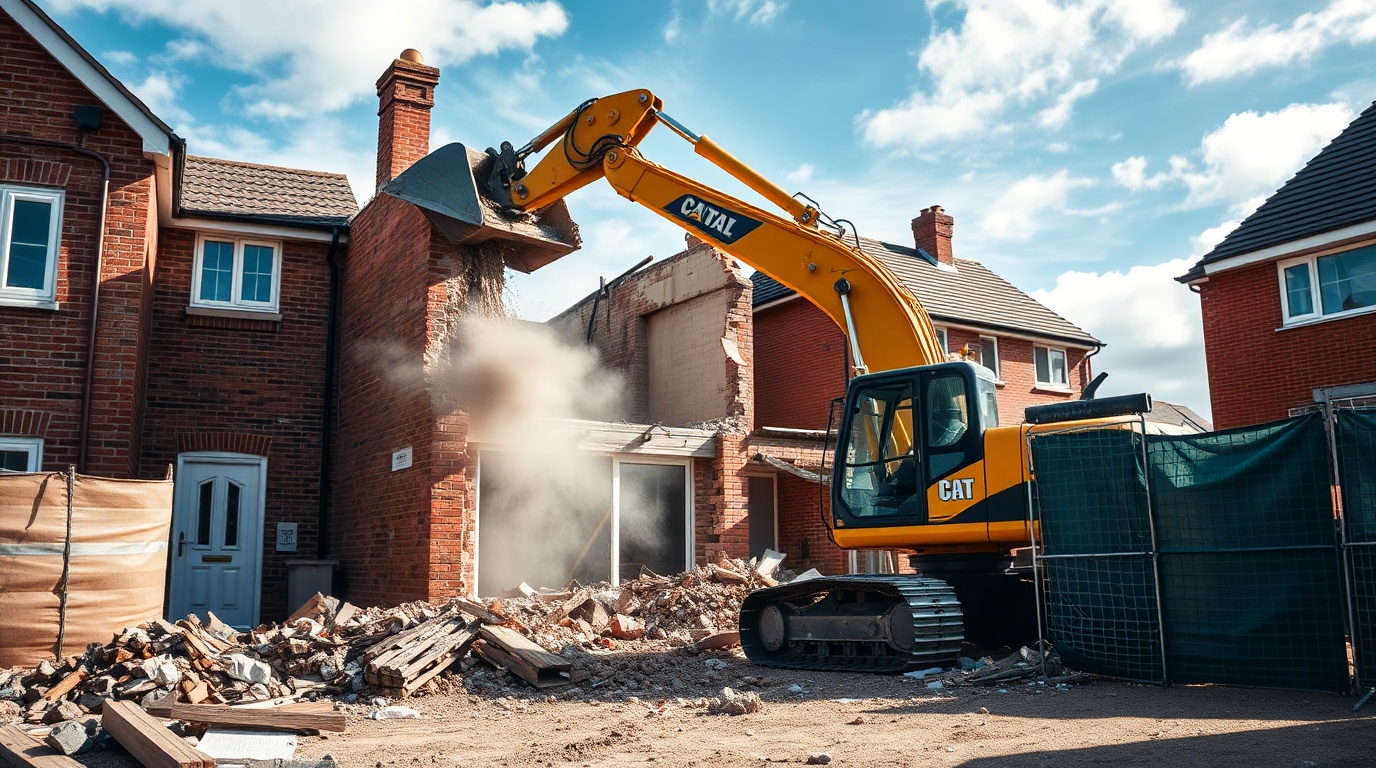
The short answer
Demolition combined with full site clearance typically costs more than demolition alone, often adding roughly £2,000 to £8,000+ on top of the take-down depending on the size of the plot, how much there is to remove, and whether foundations and hardstanding are dug out. A bare "demolition" price frequently covers only the structure above ground, whereas site clearance means grubbing out foundations and slabs, removing rubble and vegetation, and levelling the ground so the plot is ready for its next use. The combined figure is driven by the volume and type of material to remove, waste disposal and haulage, and how much excavation and levelling is required. Because the scope of "clearance" varies, it pays to define exactly what state you want the site left in before comparing quotes.
"Demolition" and "a cleared site" are not the same job, and the gap between them is where a lot of demolition budgets quietly slip. A low quote to knock a building down can leave foundations, slabs and rubble still to deal with. This page explains the gap, and what the combined work tends to cost.
Demolition + clearance
- Clearance add (typical)~£2,000–£8,000+
- Demolition coversStructure above ground
- Clearance coversFoundations, rubble, levelling
- Main cost driverWaste volume and haulage
- Define firstWhat state the plot is left in
Demolition vs full clearance
The distinction matters because a low demolition quote may leave you with foundations, slabs and rubble still to deal with. The table shows what each stage typically includes.
| Stage | Typically includes | Indicative add |
|---|---|---|
| Demolition only | Take down structure above ground | Base price |
| Foundation removal | Break out and remove slabs/footings | ~£1,000–£4,000+ |
| Grubbing out + levelling | Clear vegetation, level the plot | ~£1,000–£4,000+ |
| Waste disposal | Skips, haulage, tipping | Scales with volume |
Indicative UK figures for guidance only. Sources: Checkatrade and MyJobQuote demolition and site clearance cost guides, 2026.
What full clearance involves
- Grubbing out foundations: breaking out and removing concrete footings, ground-floor slabs and any below-ground structure.
- Removing hardstanding: driveways, paths, bases and other concrete or paved surfaces.
- Clearing vegetation and debris: stripping out overgrowth, roots and loose material.
- Levelling: grading the plot so it is even and ready for landscaping, a new build, or sale.
- Waste removal: all of the above generates significant waste, and tipping and haulage are charged by volume and type.
Why the combined cost varies
The combined demolition-and-clearance figure is even more variable than demolition alone, because it adds the excavation and waste of the below-ground and surface material to the take-down of the structure. The total swings on how much material there is to remove and how far it has to go. A small outbuilding on an open plot with a shallow base is straightforward; a larger house with deep foundations, a basement, or extensive hardstanding generates far more waste and needs more excavation and levelling. Access matters too: if a machine and skips can sit close to the work, clearance is quicker and cheaper than a tight site where material must be carried or barrowed out. Finally, what you do with the waste affects cost — segregating and recycling material such as crushed concrete or clean hardcore can reduce tipping fees, and some sites can reuse crushed material on site rather than paying to remove it.
Getting a clear-site quote that holds
Because clearance scope is where quotes most often diverge, a little precision up front prevents a large bill later. The aim is to make every contractor price the same finished plot.
- Specify the end state in writing: for example, "all structures, foundations, slabs and hardstanding removed, plot grubbed out and levelled, all waste taken away." Vague wording invites cheap quotes that exclude the expensive parts.
- Ask whether foundations are in or out: this is the single most common exclusion and the one that catches people out, so confirm it explicitly.
- Check what happens to the waste: ask whether material can be crushed and reused on site, which can cut both haulage and tipping costs.
- Confirm levelling tolerance: "levelled" for a garden is different from "levelled and compacted" ready for a foundation, so state the next use.
Defining the finished plot turns a fuzzy "clearance" line into something contractors can price consistently, and it stops a follow-on bill appearing for the foundations and rubble you assumed were included.
Matching the level of clearance to your plans
How much clearance you actually need depends entirely on what the site is for next, and matching the two avoids paying for work you don't need or, worse, leaving work undone that the next stage requires. The right level of clearance is a decision to make deliberately, not a default.
- Building straight away: if a new structure is going up, the groundworks contractor will often want the foundations out and the ground to a known level, so full clearance and grubbing out usually make sense and can be coordinated with the build to avoid duplicated effort.
- Landscaping or garden: for a garden or planting, you may not need every foundation removed, but you will want rubble cleared, the surface levelled and reasonable topsoil, which is a different specification from a building plot.
- Selling the plot: a cleared, level plot is more attractive and easier to value than one strewn with rubble and part-buried foundations, so full clearance can support the sale price.
- Leaving it for now: if nothing is happening soon, a minimal clearance that removes the structure and obvious hazards, leaving foundations in place, is the lowest-cost holding position.
Each of these implies a different scope, and therefore a different cost, so the most useful first step is to decide the site's next use before asking for quotes. A contractor can then price the exact level of clearance that suits it, and you avoid the two classic mistakes: paying to dig out foundations you could have left, or saving on clearance now only to pay more later when the next stage forces the work anyway. Clearance is not a single product but a spectrum, and choosing the right point on it for your plans is what keeps the combined demolition-and-clearance cost sensible. Decide the destination first, in other words, and the right level of clearance — and the right price for it — follows from that rather than being guessed at in advance.
Frequently asked questions
Is site clearance always included in a demolition quote?
No. Many demolition quotes cover only the structure above ground. Removing foundations, hardstanding and rubble, then levelling the plot, is often a separate line item, so confirm what the quote includes.
Can crushed rubble be reused on site?
Often yes. Concrete and clean hardcore can be crushed and reused as fill or sub-base on the same site, which reduces haulage and tipping costs. The contractor will advise whether this suits your plot and next use.
What does 'grubbing out' mean?
Grubbing out means digging up and removing below-ground material such as foundations, slabs, roots and buried structures, so the plot is clear underground as well as on the surface. It is a key part of full site clearance.
Sources & further reading
Figures on this page are typical UK ranges drawn from published sources and depend on your specific building. They are guidance, not a quotation.