The short answer
Machine demolition uses excavators and attachments to bring down larger structures quickly, while hand (manual) demolition uses people and tools for small, sensitive or hard-to-access work. Machines are chosen where there is room for plant, the structure is substantial, and speed matters; they handle heavy concrete and steel efficiently. Hand demolition is chosen for tight sites, work next to other buildings, structures being partly retained, and small jobs such as garages and outbuildings; it is slower but offers the most control. Most projects use a combination, hand work for the delicate or inaccessible parts and a machine for the bulk. The decision rests on size, access, the surroundings, what is being kept, and how much material is to be recovered.
Machine and hand demolition are not rivals but tools for different situations. The sections below compare them and explain how contractors decide which to use.
Quick comparison
- MachineFast, large structures, needs room
- HandControlled, small/sensitive, tight access
- SpeedMachine faster
- ControlHand more precise
- Most jobsUse a combination
When machine demolition is used
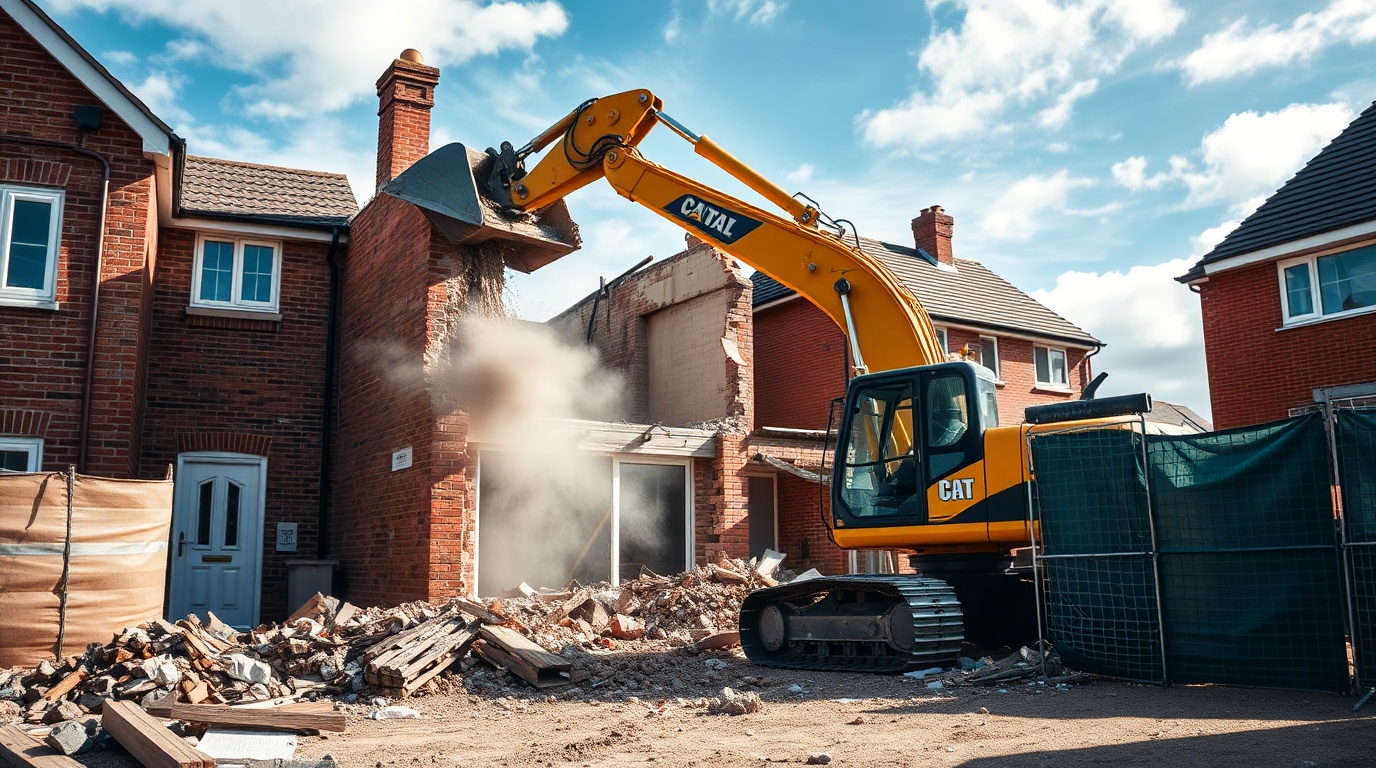
Machine demolition uses excavators fitted with attachments, breakers, pulverisers, shears, crushers and grapples, to take structures apart. It is the method of choice when the building is large or solid, when there is enough surrounding space for the machine to work and for debris to fall clear, and when speed is important. Machines deal with heavy reinforced concrete and structural steel far faster than people could, and they keep operators out of the falling zone.
The limits of machine work are access and proximity. A machine needs room to manoeuvre and a safe distance from anything being retained or from the public. On a cramped site, beside an occupied building, or where a shared wall must survive, a machine may be unsuitable for parts of the job. Even on machine-led projects, the most sensitive elements are often finished by hand.
| Factor | Machine demolition | Hand demolition |
|---|---|---|
| Speed | Fast | Slower |
| Access needed | Room for plant | Works in tight spaces |
| Control | Good, less precise | Very precise |
| Best for | Large/solid structures | Small/sensitive, retained parts |
Indicative comparison. General guidance, not a method statement.
When hand demolition is used
Hand (manual) demolition uses people with hand tools, breakers and cutting equipment to take a structure down piece by piece. It is preferred where control matters more than speed: small buildings such as garages and outbuildings, tight urban sites a machine cannot reach, work immediately next to occupied or retained buildings, and any job where a shared wall or part of the structure must be preserved. Because each element is removed deliberately, hand demolition minimises the risk to surroundings.
The trade-off is that hand demolition is slower and more labour-intensive, and therefore can cost more per unit of structure on larger jobs. It also exposes workers to more manual handling, so it is planned carefully with the right equipment and sequence. For domestic projects, though, hand demolition is often the natural choice simply because the structures are small and access is restricted.
How contractors choose
The choice between machine and hand demolition comes down to a few questions. How big and how solid is the structure? Large, heavy buildings favour machines; small ones favour hand. What is the access like? A site a machine cannot reach forces hand work. What are the surroundings? Proximity to other buildings, roads and the public pushes towards controlled hand demolition near sensitive areas. What is being retained? Shared walls and adjoining properties usually need hand work to protect them.
These decisions are set out in the demolition plan required under CDM 2015, which records the method and the safety measures. In practice the answer is often a blend: the contractor uses the fastest safe method for each part of the building. That is why asking simply whether a job is machine or hand misses the point, the real answer is usually both, applied where each is most appropriate.
Frequently asked questions
Is machine demolition always faster?
For large or solid structures with room for plant, yes, machines handle heavy concrete and steel far quicker than people. But on tight sites, beside retained buildings, or for small structures, hand demolition can be the only safe option even though it is slower.
When is hand demolition necessary?
When control matters more than speed, on small buildings, tight sites a machine cannot reach, work next to occupied or retained structures, and where a shared wall must be preserved. Hand demolition removes each element deliberately to protect the surroundings.
Can a job use both methods?
Yes, and most do. A typical project uses a hand soft strip and careful hand demolition near boundaries, then a machine for the bulk of the structure. The contractor matches the method to each part of the building.
Sources & further reading
Figures on this page are typical UK ranges drawn from published sources and depend on your specific building. They are guidance, not a quotation.