The short answer
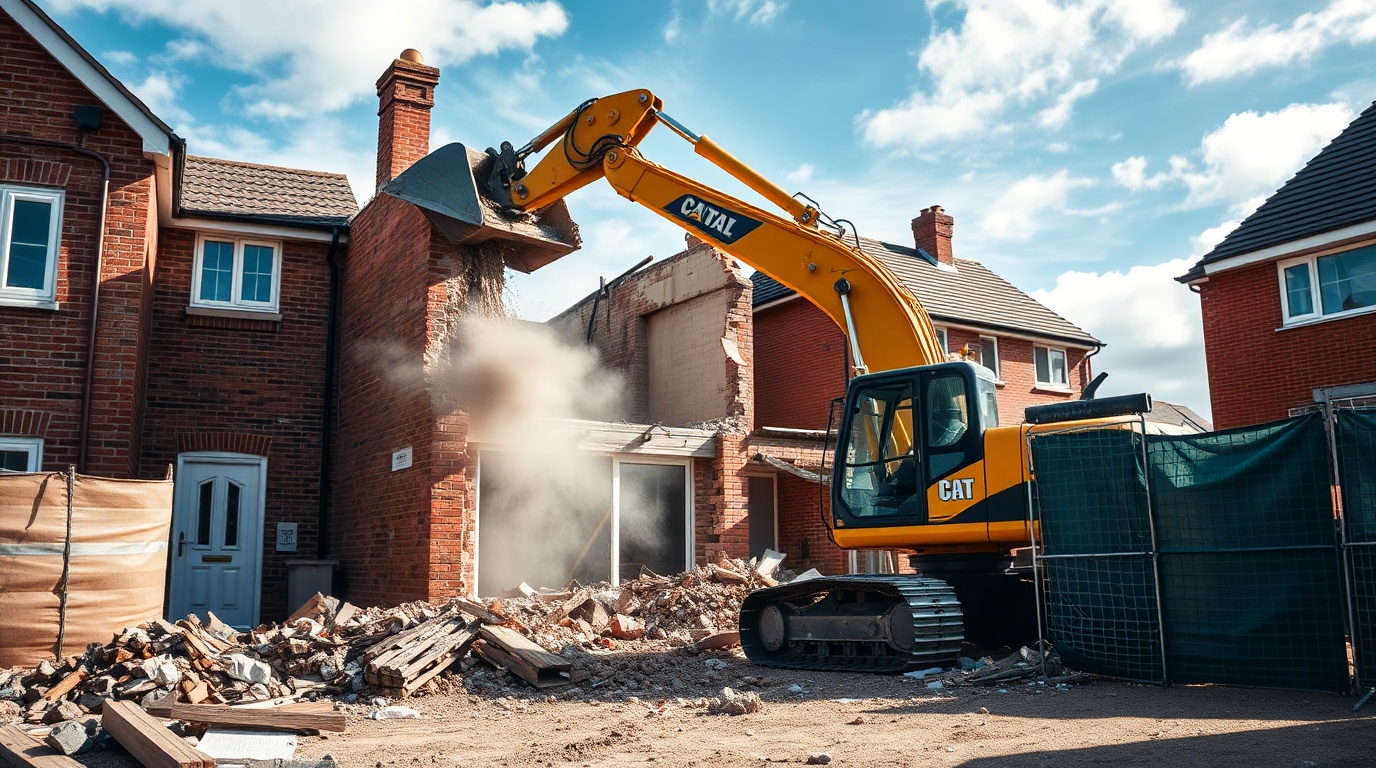
Partial or internal demolition — stripping a house back to shell, removing internal walls, or taking out part of a structure — typically costs much less than a full house demolition, often from around £1,500 to £8,000+ depending on how much is removed and whether any of it is structural. A simple soft strip (removing kitchens, bathrooms, floor coverings, fittings and non-structural items) is at the lower end. Removing load-bearing walls is more involved because it needs structural support such as a steel beam, often with a structural engineer's design and building control sign-off, which adds cost. The main drivers are the amount of material to remove, whether asbestos is present, the structural complexity, and waste disposal. As always, a site visit and an itemised quote give the real figure.
Renovations often need part of a house removed rather than the whole building. Here is what partial and internal demolition involves and what it tends to cost.
Partial / internal demolition
- Typical range~£1,500–£8,000+
- Soft stripLower end
- Structural wallsHigher — needs support
- Watch forAsbestos in older fabric
- Sign-off neededStructural / building control
Types of partial demolition and indicative cost
Cost rises with the amount removed and whether structure is involved. The table gives indicative ranges for guidance.
| Type | What it involves | Indicative cost |
|---|---|---|
| Soft strip | Fittings, finishes, non-structural | ~£1,500–£4,000 |
| Remove internal stud wall | Non-load-bearing partition | Lower end |
| Remove load-bearing wall | Needs beam and support | Higher — plus engineer |
| Strip back to shell | Most of the interior out | ~£4,000–£8,000+ |
| Waste disposal | Skips, haulage, tipping | Scales with volume |
Indicative UK figures for guidance only. Sources: Checkatrade and MyJobQuote demolition and structural cost guides, 2026.
Soft strip vs structural work
- Soft strip: removing kitchens, bathrooms, floor coverings, plasterboard, fittings and other non-structural items. Relatively quick and predictable, with cost driven mainly by volume and waste.
- Non-load-bearing walls: stud or partition walls that do not hold the building up can usually be removed straightforwardly.
- Load-bearing walls: removing a wall that supports the structure needs temporary support during the work and a permanent replacement such as a steel beam, usually with a structural engineer's design and building control approval. This is where cost and complexity rise.
- Asbestos: older interiors can contain asbestos in materials such as artex, panels or insulation, which must be checked and handled correctly.
Why the figure varies
The amount of material to remove is the most obvious driver — stripping a whole interior back to shell produces far more waste than taking out a single wall. Structural work adds the cost of temporary propping, the beam itself, the engineer's design and the building control inspection. Asbestos, if found, adds a survey and licensed removal. Access matters too: getting materials out of an upper floor of a terrace is slower than a ground-floor room with a door to the skip. And the condition of what is revealed once you start — hidden services, unexpected structural elements, or damage — can change the scope. Because internal demolition is often the first stage of a renovation, it is worth quoting carefully so the rest of the project starts from a sound, known base.
Getting partial demolition priced and signed off correctly
Internal demolition sits at the junction of demolition and structural work, so the quote needs to capture both the removal and any structural and compliance steps. Handling it methodically avoids both unsafe work and budget surprises.
- Identify load-bearing elements first: a builder or structural engineer should confirm which walls are structural before any are touched, because removing one without support risks serious damage.
- Get an engineer's design for structural openings: where a load-bearing wall is removed, the beam and supports should be designed by a structural engineer and the work approved by building control.
- Check for asbestos in older interiors: materials such as artex, panels and insulation in pre-2000 buildings may contain asbestos and should be checked before disturbance.
- Separate strip-out from structural work in the quote: a clear split between soft strip, waste and any structural openings makes the price easy to understand and compare.
- Plan the waste and access: confirm how material leaves the property and whether a skip permit is needed, since this affects both cost and disruption.
Treated this way, partial demolition becomes a controlled first stage of a renovation rather than a source of mid-project surprises. The key is to settle the structural question and the asbestos question before work starts, because both can turn a modest strip-out into a much larger job if discovered late.
How partial demolition fits into a renovation
Internal and partial demolition is rarely the end goal; it is usually the opening stage of a larger renovation, and treating it as part of that bigger project — rather than an isolated job — helps both the budget and the programme. The way the strip-out is done sets up everything that follows.
- It reveals the true condition: stripping back finishes often exposes the real state of the structure, wiring, plumbing and any damp or rot. This is valuable information that shapes the rest of the renovation, so a careful strip-out is an investigation as well as a removal.
- It defines the structural work: once you know which walls are load-bearing and what you want to open up, the structural openings and beams can be designed and approved, which is often the critical path of the whole renovation.
- It sets the waste pattern: the strip-out generates the first big batch of waste, and planning skips and access at this stage makes the later phases run more smoothly.
- It can be phased with the build: coordinating the demolition with the trades that follow avoids gaps and duplicated mobilisation, keeping the project moving.
Because of this, the best partial demolition quotes are scoped with the end design in mind, not just the removal. A contractor or builder who understands what you are building can advise on the order of work, flag where structural input is needed, and sequence the strip-out so the renovation flows on from it. Trying to price the demolition in complete isolation often leads to rework — removing something that later has to be reinstated, or leaving something that has to come out anyway. Settling the design intent, the structural questions and the asbestos position up front turns partial demolition from a risky unknown into a controlled, well-understood first step that the rest of the renovation builds on. Done well, it gives the whole renovation a clean, properly understood starting point, which is worth far more than the modest saving of rushing the strip-out.
Frequently asked questions
Do I need building control to remove an internal wall?
If the wall is load-bearing, yes — removing it affects the structure, so the replacement support (such as a steel beam) should be designed by a structural engineer and approved by building control. Removing a non-load-bearing partition usually does not require this, but check.
Is a soft strip cheaper than full internal demolition?
Yes. A soft strip removes only fittings, finishes and non-structural items, so it is quicker, lower-risk and cheaper than removing walls or stripping back to shell. Cost is driven mainly by the volume of material and waste disposal.
Could there be asbestos in my internal walls or finishes?
In older properties, yes — asbestos was used in materials such as artex, panels and some insulation. Before disturbing them, have suspect materials checked. If asbestos is present, it must be handled and removed under the correct controls.
Sources & further reading
- Checkatrade — removing a load-bearing wall cost
- HSE — asbestos essentials
- Checkatrade — demolition cost guide
Figures on this page are typical UK ranges drawn from published sources and depend on your specific building. They are guidance, not a quotation.